AURORA!!!
What is an Aurora?
An aurora is a natural, vibrant light display in the Earth's sky. It is primarily seen in high-latitude regions around the Arctic(aurora borealis) and Antarctic(aurora australis).
Auroras display dynamic patterns of radiant light that appears as curtains, rays, spirals or dynamic flickers covering the entire sky.
What causes Auroras?
The processes involved in formation of auroras are as follows:
- The Sun's Energy: The sun constantly releases a stream of charged particles(mostly elctrons and protons) known as solar wind.Massive solar events like coronal mass ejections(CMEs) can supercharge this wind with billions of tons of solar material.
- The Magnetic Field: As these particles reach earth, ourmagnetosphere(a protective magnetic shield) deflects most of them.
However, the shield is weakest at the north and south poles, allowing some particles to leak through.
- Atmospheric Collisions: Once inside,these high-speed particles slam into atoms and molecules of oxygen and nitrogen in our upper atmosphere.
- The "Glow" Process: These collisions "excite" the atmospheric atoms, giving them a temporary boost of energy.
As the atoms calm down and return to their normal state, they release that extra energy as a photon(a tiny burst of light).
Why the Different Colors?
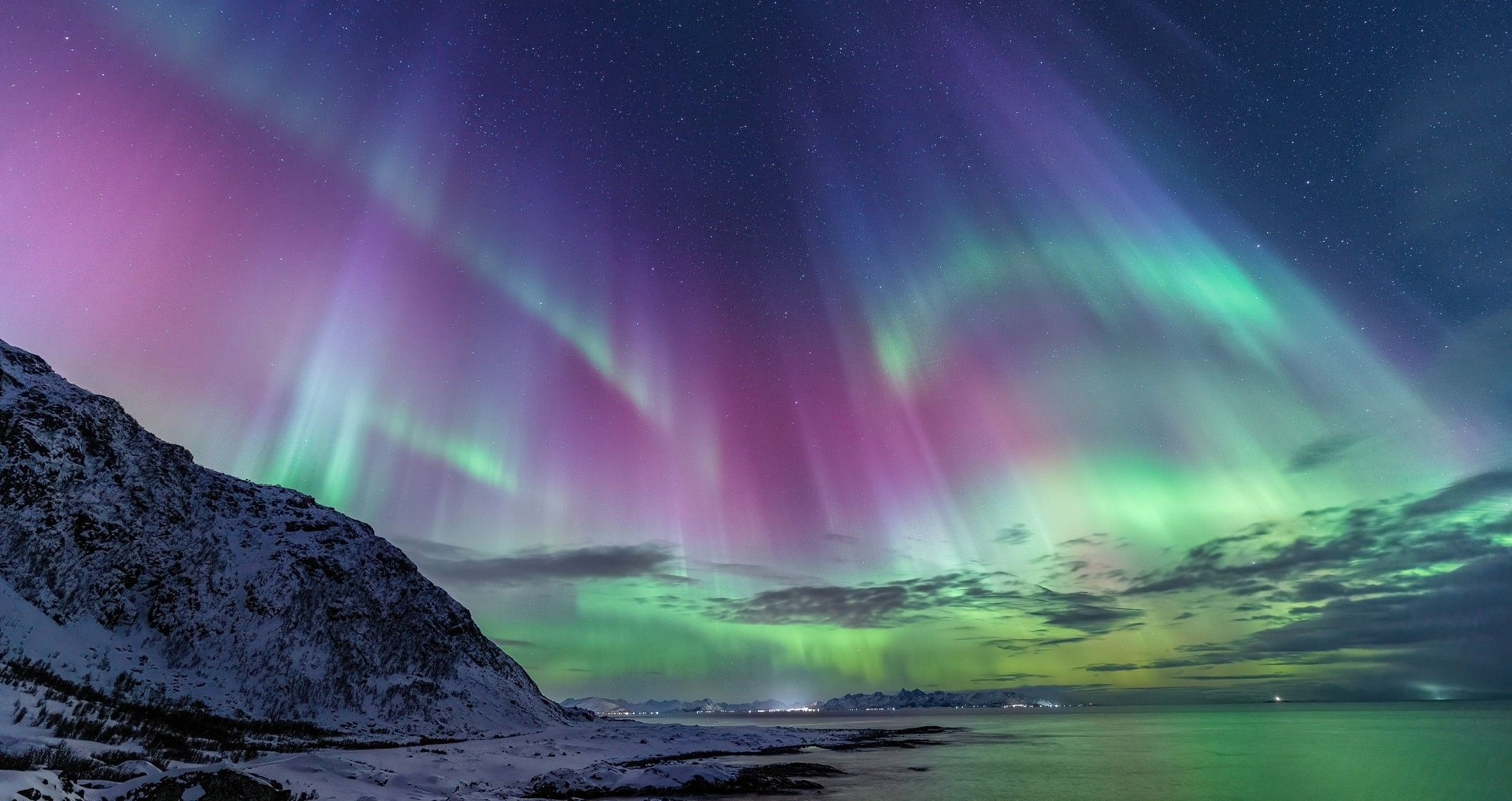
The color you see varies because charged solar particles collide with different atmospheric gases at varying altitudes, exciting them and causing them to emit
light of specific wavelengths(colors) as they release energy.
- Pale Green: The most common color, produced by oxygen atoms about 60–150 miles high.
- Red: Produced by oxygen at very high altitudes (above 150 miles) these are rarer and usually only seen during intense solar activity.
- Blue and Purple: Produced by nitrogen atoms at lower altitudes.
- Pink/Yellow: Result from a mix of oxygen and nitrogen emissions, blending colors, often seen during intense solar events.
Where to see the Auroras?
The best locations to see the Auroras are in high-latitude regions(60-700) such as Alaska, Canada, Iceland, Norway and Sweden.
The conditions to see this phenomenon is clear, cold nights when the solar activity is often higher during the months of September and March
being the optimal time of the year to watch these lights. More Information about the best loctions to watch Auroras can be found
here.
Want to Book a trip to visit this wonder. One of the websites nordic visitor quotes:
"Northern lights tours in Iceland
Iceland’s dark skies set the stage for the northern lights. Greens. Violets. Colours that ripple overhead. On your Iceland northern lights tour, you’ll chase the aurora your way – self-drive or guided.
We’ll sort your stays, local transport, and the best spots to watch the show."
Contact nordic@visitor to book your trip now!!!!